1991 Honda Civic SIR - Vicious Circle

1991 HONDA CIVIC SIR (EG6) - Specifications
Performance Exhaust Systems

Exhaust gases leaving your engine pass through three to four different stages before finally leaving your exhaust tip at the rear of your car. The first exhaust gases pass through an exhaust manifold or header which re-directs the exhaust from each cylinder into a single outlet or two outlets on depending on the type of engine.
Then the exhaust gases pass through a catalytic converter,through the cat-back section of the exhaust tip. Turbocharged vehicles have a turbocharger mounted to the exhaust manifold that is spun by exhaust gases. The primary purpose of the factory cat-back exhaust is to muffle the sound and redirect the exhaust to a suitable place of exit.
Upgrading to an aftermarket cat-back exhaust is a great place to start tuning your car. On turbocharged applications the manufacturers often design the exhaust to be restrictive to keep boost near stock levels. On some turbocharged applications simply changing an exhaust can free up 25-30hp. On a normally aspirated car an aftermarket exhaust becomes essential if you plan on seriously tuning your car. Headers typically add 8-10hp depending on application.
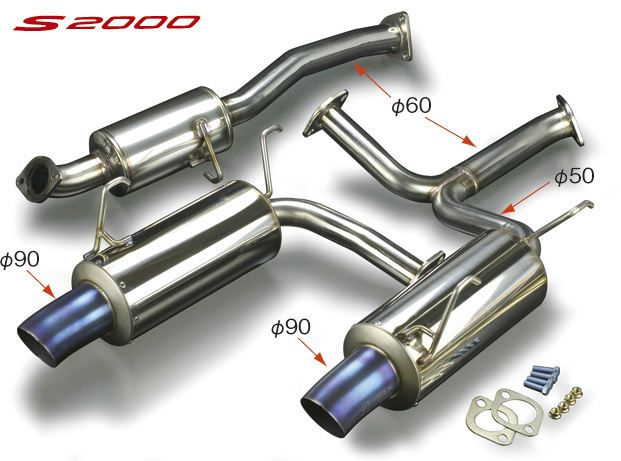
Different designs alter the torque and horsepower characteristics for different powerbands. Long primaries can boost top end power while shorter 4-2-1 designs can tune in more low to mid range torque. Depending on how flow restrictive your stock exhaust system is will determine how much power gains you get by upgrading to an aftermarket system.

Top Performance Add-ons
Performance enthusiasts are always in search of more power because there's never enough. However, the correct combination of performance products can leave you satisfied. It just takes a lot of time and patience to figure out what your vehicle responds to best. First,You need an air filter, header, exhaust, throttle body, cams, adjustable cam sprockets, and ported head. To draw more power, a turbocharger, supercharger and/or NOS can be added.

The following is a list of the top performance upgrades that really work:
Headers Updated
Aftermarket headers direct exhaust gases outward and increase the velocity at which they exit. This is accomplished through the design and size of the primary tubes.
Airfilters
Air filters are designed to increase the velocity and amount of incoming air while preventing dust and dirt particles from causing engine failure.
Exhaust Systems Updated
Mandrel-bent larger piping and a free-flowing muffler lead to increased flow, which translates into more HP. Most aftermarket systems utilize factory mounting brackets.
Ignition Systems
Ignition amplifiers usually feature a rev limiter and sometimes a retard unit. During low RPM, multiple sparks are used to ease start-ups while intensified sparks ignite the air/fuel mixture at higher RPM.
Throttle Body
Overboard throttle bodies improve overall throttle response and increase HP throughout the entire RPM band. Match-porting the intake manifold is required in order to utilize the full potential of the throttle body.
Camshafts
Camshafts can be designed to increase low-end and/or high- end torque and HP. Many cams are regrinds, so you can't get that crazy lift or duration like you can from a billet cam.
Sprockets
With adjustable cam sprockets, cam timing can be advanced or retarded by a few degrees. Low0end torque and top-end HP can be realized through tuning the sprockets.
Cylinder Heads
Before purchasing a ported cylinder head, be sure that a flow bench is ued. If not the port could be hurting the performance of your vehicle.
Forced Induction
Turbochargers and superchargers have identical objectives- -to force additional air to the combustion chambers. However, turbochargers are exhaust driven and superchargers are belt driven.
Nitrous Oxide Systems (NOS)
One of the quickest and easiest ways to increase HP is through NOS. HP gains are accomplished by changing the jet size.
Intake Manifold
Headers, intakes, exhaust systems, and throttle bodies can improve your power by helping the car inhale air and exhale air easier. Since intake air travels into the intake manifold after the throttle body, your stock intake manifold can become a performance bottle neck and may not allow your car to "breath" properly.
Spark Plugs/Wires
Are used to conduct and maximise the maximum output generated by conventional and racing ignition systems.
Vtec Controllers
The purpose of a vtec controller is to control the vtec engangement point.