
Honda NSX in Excess

Honda's randy looking NSX can only be called a SuperCar. In standard form its 3.2 litre all-alloy V6 punches out 206kW and the sophisticated suspension and mid-mount engine design fits the traditional sports car formula perfectly. But slip a couple of turbos between the rear wheels and a SuperCar just got super-er! No longer does it compete in the Supra RZ category; it's now hot on the heels of Marranello's finest.

And that's where Australia's Advanced Vehicle Operations (AVO) steps into the limelight. Initially, they twin turbo'd the car using the standard engine internals and low boost pressure, but the simple seduction of tuning up the boost soon saw the limits of the standard pistons...
Then it was time to get serious. Presented with the task of getting around 550hp, AVO responded with a bullet-proof engine build and one of the most well engineered 'one-offs' we've ever seen. The Honda V6 has been split open and re-built with a set of American-sourced forged pistons that provide a more turbo-friendly compression ratio of 9.1:1 - down from the factory's 10.2:1. The bottom-end remains near standard, keeping Honda's factory titanium rods but with specially made ARP rod bolts. Terry Wilson of AVO enthused about the strength and design features of the Honda engine, saying it's incredibly well balanced and uses such features as main bearing girdle strengthening all ex-factory.

Fabricating a pair of exhaust manifolds was an exercise in compact packaging. These labour intensive custom three-into-one tubular headers channel gases into the turbines, while short length twin 3 inch pipes and an AVO muffler are used post-turbo. Each of the Garrett-based '320hp' ball-bearing turbos delivers around 10psi boost into individual AVO air-to-air intercoolers, mounted proud behind the custom Lexan rear window. Getting air to flow through the cores took some ingenuity - you can't just stick them out the front when you've got a mid-engined car (not without 3 miles of plumbing anyway!).

Fuel and spark come courtesy of the Honda ECU, which has been augmented with an in-house AVO extra injector driver and six extra injectors mounted one near each intake port. This system works very well and the engine also benefits slightly from the cooling effect of the fuel being injected into the intake runners. The engine dines on a minimum fuel grade of premium unleaded, but will be seeing Elf race fuel very soon - we'll let you know why later! Because the standard ECU remains in place, the stock rev limit is still imposed at around 8000rpm - it's the turbo-torque which enables the big hp numbers to be produced.

 Backing the alloy V6 is the standard NSX 5-speed manual gearbox. It's been filled with stronger NSX-R gears plus a 40% higher clamping force pressure plate with a twin plate clutch. The factory limited slip diff copped a reworking too, with AVO strengthening and modified it to nearly the lock-up stage.
Racetrack ready, the 1200-odd kg car is now suspended by fully adjustable Mugen front and rear dampers and Mugen springs. Stock anti-roll bars are still fitted. The car's handling is just mind-blowing. Turn-in is crisp and precise and the car's exit attitude can be easily throttle controlled with the hit of around 550hp! With the car's estimated 320km/h terminal speed, the braking department was brought up to spec with pizza-dish sized 13.5 inch Brembos with four-pot squeezers. Cameron says there's absolutely no fade and the overall braking performance is totally unlike any other car he's been in.
Spark Plug

1. Installing spark plugs
Torque is one of the most critical aspects of spark plug installation.Torque directly affects the spark plugs' ability to transfer heat out of the combustion chamber. A spark plug that is under-torqued will not be fully seated on the cylinder head, hence heat transfer will be slowed. This will tend to elevate combustion chamber temperatures to unsafe levels, and pre-ignition and detonation will usually follow. Serious engine damage is not far behind.
An over-torqued spark plug can suffer from severe stress to the Metal Shell which in turn can distort the spark plug's inner gas seals or even cause a hairline fracture to the spark plug's insulator...in either case, heat transfer can again be slowed and the above mentioned conditions can occur.The spark plug holes must always be cleaned prior to installation, otherwise you may be torquing against dirt or debris and the spark plug may actually end up under-torqued, even though your torque wrench says otherwise. Of course, you should only install spark plugs in a cool engine, because metal expands when its hot and installation may prove difficult.

2. Gapping
Since the gap size has a direct affect on the spark plugs' tip temperature and on the voltage necessary to ionize(light) the air/fuel mixture, careful attention is required. While it is a popular misconception that plugs are pre-gapped from the factory, the fact remains that the gap must be adjusted for the vehicle that the spark plug is intended for.Those with modified engines must remember that a modified engine with higher compression or forced induction will typically require a smaller gap settings (to ensure ignitability in these denser air/fuel mixtures). As a rule, the more power you are making, the smaller the gap you will need.
A spark plug's voltage requirement is directly proportionate to the gap size. The larger the gap, the more voltage is needed to bridge the gap. Most experienced tuners know that opening gaps up to present a larger spark to the air/fuel mixture, maximizing burn efficiency. It is for this reason that most racers add high power ignition systemsthe added power allows them to open the gap yet still provide a strong spark.With this mind, many think the larger the gap the better. In fact, some aftermarket ignition systems boast that their systems can tolerate gaps that are extremebe wary of such claims. In most cases, the largest gap you can run may still be smaller than you think.
3. Indexing "For racers only!"
Indexing refers to a process whereby auxiliary washers of varying thickness are placed under the spark plug's shoulder so that when the spark plug is tightened, the gap will pointed in the desired direction.
However, without running an engine on a dyno, it is impossible to gauge which type of indexing works best in your engine...while most engines like the spark plug's gap open to the intake valve, there are still other combinations that make more power with the gap pointed toward the exhaust valve.
In any case, engines with indexed spark plugs will typically make only a few more horsepower, typically less than 1% of total engine output...for a 500hp engine, you'd be lucky to get 5hp...while there are exceptions, the bottom line is that without a dyno, gauging success will be difficult.
4. Heat Range selection
Let's make this really simple: when you need your engine to run a little cooler, run a colder plug. When you need your engine to run a little hotter, run a hotter spark plug. However, NGK strongly cautions people that going to a hotter spark plug can sometimes mask a serious symptom of another problem that can lead to engine damage. Be very careful with heat rangesseek professional guidance if you are unsure.
With modified engines (those engines that have increased their compression), more heat is a by-product of the added power that normally comes with increased compression. In short, select one heat range colder for every 75-100 hp you add, or when you significantly raise compression. Also remember to retard the timing a little and to increase fuel enrichment and octane. These tips are critical when adding forced induction (turbos, superchargers or Nitrous kits), and failure to address ALL of these areas will virtually guarantee engine damage.An engine that has poor oil control can sometimes mask the symptom temporarily by running a slightly hotter spark plug. While this is a "Band-Aid" approach, it is one of the only examples of when and why one would select a hotter spark plug.
5. Using "racing" spark plugs
Be cautious!! In reality, most "racing" spark plugs are just colder heat ranges of the street versions of the street spark plug...they don't provide any more voltage to the spark plug tip!! Their internal construction is no different (in NGK's case, as all of our spark plugs must conform to the same level of quality controls) than most standard spark plugs. There are some exceptions, though. Extremely high compression cars or those running exotic fuels will have different spark plug requirements and hence NGK makes spark plugs that are well-suited for these requirements...they are classified as "specialized spark plugs for racing applications". Some are built with precious metal alloy tips for greater durability of for their ability to fire in denser or leaner air/fuel mixtures.
However, installing the same spark plugs Kenny Bernstein uses in his 300+mph Top Fuel car (running Nitromethane at a 2:1 air/fuel ratio and over 20:1 dynamic compression) in your basically stock Honda Civic (running 15:1 a/f ratios with roughly 9.5:1 compression) will do nothing for you!! In fact, since Kenny's plugs are fully 4 heat ranges colder, they'd foul out in your Honda in just a few minutes. NGK as a company tries to stay clear of saying that a racing spark plug (or ANY spark plug) will give you large gains in horsepower...while certain spark plugs are better suited to certain applications (and we're happy to counsel you in the right direction) we try to tell people that are looking to "screw in" some cheap horsepower that, in most cases, spark plugs are not the answer.
To be blunt, when experienced tuners build race motors, they select their spark plugs for different reasons: to remove heat more efficiently, provide sufficient spark to completely light all the air/fuel mixture, and to survive the added stresses placed upon a high performance engine's spark plugs, and to achieve optimum piston-to-plug clearance. Some of these "specialized racing plugs" are made with precious metal alloy center/ground electrodes or fine wire tips or retracted-nose insulators...again, these features do not necessarily mean that the spark plug will allow the engine to make more power, but these features are what allow the spark plug to survive in these tortuous conditions....most racers know screwing in a new set of spark plugs will not magically "unlock" hidden horsepower.
6. Using high power ignition systems
Many of the more popular aftermarket ignition systems are of the capacitive discharge type. They store voltage, or accumulate it, until a point at which a trigger signal allows release of this more powerful spark. Companies like Mallory, MSD, Crane and Accel, to name a few, offer such systems.
They affect spark plugs in that they allow the gaps to be opened up to take advantage of the increased capacity. The theory is that the larger and the more intense the spark you are able to present to the air/fuel mixture, the more likely you will be to burn more fuel, and hence the more power you will make.Only use on modified or older non-computer controlled vehicles.
In reality, computer controlled vehicles do such a good job of lighting off the air/fuel mixture (as evidence by the ultra-low emissions), added ignition capacity would do little to burn more fuel since the stock configuration is doing such a good job. Older non-computer controlled vehicles or those that have been modified with higher compression or boosted (nitrous, turbo, supercharged) engines can certainly take advantage of a more powerful ignition system.
JUN modified Prelude H22a VTEC
Testing Yellow Honda Prelude From JUN
OVERHEATING!!!!
WHEN AN ENGINE OVERHEATS
Engines are designed to operate within a "normal" temperature range of about 190 to 220 degrees F. A relatively consistent operating temperature is absolutely essential for proper emissions control, good fuel economy and performance.
If the engine overheats and exceeds its normal operating range, the elevated temperatures can cause extreme stress in the cylinder head which may result in a head gasket failure. This is especially true with aluminum cylinder heads because aluminum expands about two to three times as much as cast iron when it gets hot. The difference in thermal expansion rates between an aluminum head and cast iron block combined with the added stress caused by overheating can cause the head to warp. This, in turn, may lead to a loss of clamping force in critical areas and allow the head gasket to leak.
What else can happen when an engine overheats? Coolant can boil out of the radiator and be lost. Pistons swell inside their cylinders and can scuff or seize. Valve stems can swell in their guides and also scuff or seize. This, in turn, may damage valve train components (broken rocker arms, bent pushrods, etc.) or possibly result in damaging contact between the valve head and piston if the valve sticks open. Valve lifters can also stick, possibly causing a valve to remain open a little too long. Bearings can seize. Cylinder heads can crack (especially if someone dumps cold water into the radiator in an attempt to "cool off" the engine). Combustion chambers can become so hot that a spark is no longer needed to ignite the fuel, leading to a condition known as "preignition" where the engine misfires and
runs erratically. Air/fuel mixtures are upset, and gasoline becomes less able to resist detonation. Oil thins out and is less able to protect the engine's internal components against friction and wear.
Use a straight edge and feeler gauge to check the flatness of the face of the cylinder head and block deck for warpage before replacing the head gasket.
IF AN ENGINE HAS OVERHEATED...
If a head gasket has failed as a result of severe engine overheating, both the face of the cylinder head and block deck should be checked for warpage -- and resurfaced if needed to restore flatness prior to replacing the head gasket. If the face of the head and/or block deck are not flat and are not resurfaced when the head gasket is replaced, the new head gasket will be unevenly loaded and will likely leak or fail.
Flatness can be checked by placing a straight edge on the face of the cylinder head or block, and then using a feeler gauge to check any gaps between the straight edge and head or block. If the amount of warpage exceeds the following maximum limits, the head or block is not flat enough to hold a good seal against the head gasket and should be resurfaced:
The surface finish on the face of the head and block is also important. The surface finish should be 54 to 113 RA microinches (60 to 125 RMS), with a recommended range of 80 to 100 RA (90 to 110 RMS).
If the surface is too rough (more than 113 RA), it may be too rough to seal properly and the head gasket will leak. If the surface is too smooth (less than 54 RA), it may not provide enough "grip" to prevent the gasket from flowing or scrubbing.
WHAT CAUSES OVERHEATING?
Overheating can be caused by anything that decreases the cooling system's ability to
absorb, transport and dissipate heat: A low coolant level, loss of coolant (through internal or external leaks), poor heat conductivity inside the engine because of accumulated deposits in the water jackets, a defective thermostat that doesn't open, poor airflow through the radiator, a slipping fan clutch, an inoperative electric cooling fan, a collapsed lower radiator hose, an eroded or loose water pump impeller, or even a defective radiator cap.
One of nature's basic laws says that heat always flows from an area of higher temperature to an area of lesser temperature, never the other way around. The only way to cool hot metal, therefore, is to keep it in constant contact with a cooler liquid. And the only way to do that is to keep the coolant in constant circulation. As soon as the circulation stops, either because of a problem with the water pump, thermostat or loss of coolant, temperatures begin to rise and the engine starts to overheat.
The coolant also has to get rid of the heat it soaks up while passing through the block and head(s). So the radiator must be capable of doing its job, which requires the help of an efficient cooling fan at slow speeds. Finally, the thermostat must be doing its job to keep the engine's average temperature within the normal range. If the thermostat fails to open, it will effectively block the flow of coolant and the engine will overheat.
WHAT TO CHECK
If your engine overheated and the cause hasn't been determined, all of the following should be checked to make sure the engine doesn't overheat again:

Thermostat
Severe overheating can often damage a good thermostat. Therefore, if the engine has
overheated because of another problem, the thermostat should be tested or replaced
before the engine is returned to service.
One way to check the thermostat is to start the engine and feel the upper radiator hose. The hose should not feel uncomfortably hot until the engine has warmed-up and the thermostat opens. If the hose does not get hot, it means the thermostat is not opening.
Another way to test the thermostat is to remove it and dip it into a pan of boiling water (it should open). The exact opening temperature can be checked by using a thermometer.
If the thermostat needs to be replaced, install one with the same temperature rating as the original. Most cars and light trucks since 1971 require thermostats with 192 or 195 degree ratings. Using a cooler thermostat (160 or 180 degree) can increase fuel and oil consumption, ring wear and emissions. On newer vehicles with computerized engine controls, the wrong thermostat can cause major performance and emission problems if the engine fails to reach the proper operating temperature. Cooling system leaks Loss of coolant because of a leak is probably the most common cause of overheating. Possible leak points include hoses, the radiator, heater core, water pump, thermostat housing, head gasket, freeze plugs, automatic transmission oil cooler, cylinder head(s) and block.
Make a careful visual inspection of the entire cooling system, and then pressure test the cooling system and radiator cap. A pressure test will reveal internal leaks such as seepage past the head gasket (usually due to warpage in the head or block, too rough a surface finish on the head or block, or improperly torqued head bolts) as well as cracks in the head(s) or engine block. If there are no leaks, the system should hold pressure for at least a minute or more.
It's important to pressure test the radiator cap too, because a weak cap (or one with a pressure rating too low for the application) can allow coolant to escape from the radiator. Fan With mechanical fans, most overheating problems are caused by a faulty fan clutch -- though a missing fan shroud can reduce the fan's cooling effectiveness by as much as 50% (depending on the fan's distance from the radiator) which may be enough to cause the engine to overheat in hot weather or when working hard.
The fan clutch disengages the fan when less cooling is needed to reduce the parasitic horsepower drain on the engine as well as fan noise. Inside the clutch is a special silicone fluid that acts like a fluid coupling to turn the fan. Above a certain r.p.m., the resistance created by the fan exceeds the shear characteristics of the fluid and the fan ceases to spin any faster. "Thermal" fan clutches also have a bimetal thermostat spring on the front that increases or decreases the amount of slippage depending on the temperature of the air flowing through the radiator. This allows more or less cooling as needed.
Defective fan clutches are a common and often overlooked cause of overheating. The
shear characteristics of the clutch fluid gradually deteriorates over time, with an average loss in drive efficiency of about 200 r.p.m. per year. Eventually, slippage reaches the point where effective cooling is no longer possible and overheating results. (On average, the life of a fan clutch is about the same as a water pump. If one needs to be replaced, the other usually does too.)
If the fan clutch shows signs of fluid leakage (oily streaks radiating outward from the hub of the clutch), spins freely with little or no resistance when the engine is off, or wobbles when the fan is pushed in or out, it needs to be replaced.
With an electric cooling fan, check to see that the fan cycles on when the engine gets hot and when the air conditioner is on. If the fan fails to come on, check the fan motor wiring connections, relay and temperature sensor.
Try jumping the fan directly to the battery. It it runs, the problem is in the wiring, relay or sensor. If it fails to run, the fan motor is bad and needs to be replaced.
Water pump
Any wobble in the pump shaft or seepage would call for replacement. In some instances, a pump can cause an engine to overheat if the impeller vanes are badly eroded due to corrosion or if the impeller has come loose from the shaft. The wrong pump may also cause an engine to overheat. Some engines with serpentine drive belts require a special water pump that turns in the opposite direction of those used on the same engine with ordinary V-belts.
Belts & hoses
Check belt tension and condition. A loose belt that slips may prevent the water pump from circulating coolant fast enough and/or the fan from turning fast for proper cooling.
The condition of the hoses should also be checked. Though not leaking now, internal
corrosion or old age may make them vulnerable to sudden failure. Radiator and heater
hoses should be replaced if leaking, cracked, brittle, mushy feeling or otherwise damaged.
Make sure the clamps are tight, too.
Sometimes a lower radiator hose will collapse under vacuum at high speed and restrict the flow of coolant from the radiator into the engine. This can happen if the reinforcing spring inside the hose is missing or damaged.
Radiator
The most common problems radiators fall prey to are clogging (both internal and external)and leaks. Dirt, bugs and debris can block air flow through the core and reduce the radiator's ability to dissipate heat.
Internal corrosion and an accumulation of deposits can likewise inhibit coolant circulation and reduce cooling. "Backflushing" the radiator and cooling system when changing coolant is highly recommended to dislodge accumulated deposits and to flush the remaining coolant from the engine block. Backflushing is running water back through the radiator and engine in the opposite direction to which it normally flows. After the coolant has been drained from the radiator, a T-fitting is installed in the heater inlet hose. The fitting is then connected to a pressurized water hose or power flusher. The water is turned on and the system is reverse flushed. The flushing should be continued until only clean water emerges from the
radiator. Cleaning chemicals may also be used to remove accumulated deposits from the system.
When the cooling system is refilled, use a 50/50 mixture of ethylene glycol antifreeze and water. This will give freezing protection down to -34 degrees Fahrenheit, and boiling protection to 265 degrees F. in a pressurized system with a 14 psi radiator cap. A 70/30 mixture will protect against freezing down to -84 degrees F. and boilover up to 276 degrees F. Do not use more than 70% antifreeze because antifreeze carries heat less efficiently than water. Straight water should never be used in the cooling system because it offers no boilover or freezing protection and no corrosion protection (which is extremely important in today's bimetal and aluminum engines).
When refilling the cooling system, be sure you get it completely full. Air pockets in the head(s), heater core and below the thermostat can interfere with proper coolant circulation and cooling. Some cars (mostly front-wheel drive) may have one or more "bleeder valves" for venting trapped air from the cooling system. On some vehicles, it may be necessary to temporarily loosen a heater hose to get all the air out of the system.
Other factors that can contribute to overheating include retarded ignition timing, detonation/preignition, a lean air/fuel mixture, exhaust restrictions (partially plugged converter or muffler), a radiator that's too small for the engine, and overworking the engine (towing, mountain driving, etc. in unusually hot
weather).

B18 Series

B18A
The B18A is not considered part of the modern B-series family. This engine shares many characteristics with the B20A/B21 See Honda B20A engine.
* Non-VTEC
* Found in:
o 1986-1989 Accord Aerodeck LXR-S/LX-S (Japan)
o 1986-1989 Accord EXL-S/EX-S (Japan)
o 1986-1989 Vigor MXL-S (Japan)
+ Displacement: 1,834 cc (111.9 cu in)
+ Compression: 9.4:1
+ Bore: 81 mm (3.2 in)
+ Stroke: 89 mm (3.5 in)
+ Dual Keihin Carbs
+ Power: 100 hp (75 kW) @ 6100 rpm & 128 lb·ft (174 N·m) @ 4700 rpm
+ Transmission: A2N5, E2N5
B18A1
* NON -VTEC
* Found in: 1990-1993 Acura Integra usdm "RS/LS/GS" (DA9, DB1)
+ Displacement: 1,834 cc (111.9 cu in)
+ Compression: 9.2:1
+ Bore: 81 mm (3.2 in)
+ Stroke: 89 mm (3.5 in)
+ Rod Length: 137.01 mm (5.394")
+ Rod/Stroke Ratio: 1.54
+ Redline: 6500 rpm
+ Rev Limiter: 7200
+ Programmed fuel injection
+ Power: 90-91 Only: 130 bhp (97 kW) @ 6000 rpm & 121 ft·lbf (164 N·m) @ 5000 rpm
+ Power: 92-93 Only: 140 bhp (100 kW) @ 6300 rpm & 126 ft·lbf (171 N·m) @ 5000 rpm
+ Transmission: 90-91: A1,S1, cable
+ Transmission: 92-93: YS1, cable
B18B1
* NON-VTEC
* Found in: 1994-2001 Acura Integra "RS/LS/GS/SE" (DC4/DB7)
+ Displacement: 1,834 cc (111.9 cu in)
+ Compression: 9.2:1
+ Bore: 81 mm (3.2 in)
+ Stroke: 89 mm (3.5 in)
+ Rod Length: 137.01 mm (5.394")
+ Rod/Stroke Ratio: 1.54
+ Power: 142 hp (106 kW) @ 6300 rpm & 127 ft·lbf (172 N·m) @ 5200 rpm
+ Redline: 6800 rpm
+ Rev Limit: 7200 rpm
+ Transmission: Y80/S80
B18B4
* NON-VTEC
* Found in: 1996-2000 Honda Ballade 180i
+ Displacement: 1,834 cc (111.9 cu in)
+ Compression: 9.2:1
+ Bore: 81 mm (3.2 in)
+ Stroke: 89 mm (3.5 in)
+ Rod Length: 137.01 mm (5.394 in)
+ Rod/Stroke Ratio: 1.54
+ Power:
+ Redline: 7200 rpm
# 142 hp (106 kW) @ 7000 rpm & 127 ft·lbf (172 N·m) @ 5200 rpm
+ Transmission: Y80/4254245
JDM B18C
SPEC R
* VTEC
* Found in:
o 95-00 JDM Honda Integra Type R DC2
o 95-00 JDM Honda Integra Type R DB8
+ Rev-limit: 8600 rpm
+ Power: 200 PS (147 kW; 197 hp) @ 8000 rpm & 17.5 kg·m (172 N·m; 127 ft·lbf) @ 7500rpm (96 spec) 18.5kgm @ 6200 rpm (98 spec)
+ Transmission: S80 with Helical LSD
+ S80 spec: J4D (96specR & 4.4 final drive), N3E (98specR & 4.785 final drive)
+ Displacement: 1,797 cc (109.7 cu in)
+ Compression: 11.1:1
+ Bore: 81 mm (3.2 in)
+ Stroke: 87.2 mm (3.4 in)
+ Rod Length: 137.9 mm (5.4 in)
+ Rod/Stroke Ratio: 1.58
+ VTEC Engagement @ 5800 rpm
+ ECU code: P73-003 (96specR) P73-013 (98specR)
(Source: BMI Vol.1 Type R Legend)
SiR/GSR
* VTEC
* Found in:
o 93-95 JDM Honda Integra Si (DB8, DC2)
o 95-98 JDM Honda Integra SiR/SiR II (DB8, DC2)
o 98-99 JDM Honda Integra SiR-G (DB8, DC2)
+ Identification: Black valve cover with dual runner intake manifold
+ Rev-limit: 8000 rpm
+ Power: 132.39 kW (180 PS; 178 bhp) @ 7200 rpm & 128 ft·lbf (174 N·m) @ 6200 rpm
+ Displacement: 1,797 cc (109.7 cu in)
+ Compression: 10.6:1
+ Bore: 81 mm (3.2 in)
+ Stroke: 87.2 mm (3.4 in)
+ ECU code: P72
Highlights of B18C Spec R compared to standard B18C GSR
1. Camshaft - Wide-angled, high-lift, high-durability camshaft
2. Exhaust Valve Spring - High-lift, dual-layered spring
3. Spark plug - High-heat-type #7 platinum plug
4. Engine Stiffener - Aluminum die-cast, high-durability, one-piece type
5. Crankshaft - Full-counterweight, 8-weight, high-output, custom crankshaft
6. Connecting Rod - Custom TypeR rod, high-durability, lightened
7. Pistons - High-compression, low-friction, custom pistons
8. Inlet Valves - Lightened inlet valves
9. Intake Manifold - Custom tuning, single-port type.
10. Throttle Body - 62 mm (2.4 in) wide-mouth throttle body.
11. Inlet Valve Springs - High-lift, flat-surfaced, dual-layered spring
12. Port Buffing done by hand
13. Fastening of Connecting Rod done with micrometer
14. All stainless steel headers
B18C1
* VTEC
* Found in:
o 1994-2001 USDM Integra GS-R (DC2/DB8)
+ Displacement: 1,797 cc (109.7 cu in)
+ Compression: 10.0:1
+ Bore: 81 mm (3.2 in)
+ Stroke: 87.2 mm (3.4 in)
+ Rod Length: 137.9 mm (5.4 in)
+ Rod/Stroke Ratio: 1.58
+ Power: 170 hp (127 kW) @ 7600 rpm
+ Torque: 128 lb·ft (174 N·m) @ 6200 rpm
+ Redline: 8100 rpm (Fuel cut-off @ 8200 rpm)
+ VTEC Engagement @ 4400 rpm
+ Transmission: Y80(No LSD) 5-Speed Manual Transaxle
B18C2
* VTEC
* Found in:
o 1994-1999 Honda Integra VTi-R
o AUDM Spec 1993-1999 Honda Integra VTi-R
+ Displacement: 1,797 cc (109.7 cu in)
+ Compression: 10:1
+ Power: 168 hp (125 kW) @ 7600 rpm
+ Torque: 128 lb·ft (174 N·m) @ 6200 rpm
+ Redline: 8200 rpm
+ Fuel Cut: 8300 rpm
+ Transmission: Y80(No LSD) 5-Speed Manual Transaxle
B18C3
* VTEC
* Found in:
o 1995-1998 Honda Integra Type R
* Power: 193 PS (142 kW; 190 hp) @ 8200 rpm & 127 lb·ft (172 N·m) @ 7500 rp
B18C4
* VTEC
* Found in:
o 1996-2000 UK Civic 1.8i VTi 5-door Hatch (MB6)
o 1996-2000 UK Civic 1.8i VTi-S (Limited Edition) 5-door Hatch (MB6)
o 1996-2000 UK Civic Aerodeck 1.8i VTi 5-door Wagon (MC2)
o 1998-1999 EU Civic Aerodeck 1.8i VTi 5-door Wagon (MC2)
o 1998-1999 EU Civic 1.8i VTi 5-door Hatch (MB6)
* Displacement: 1,797 cc (109.7 cu in)
* VTEC engagement@4,400 rpm
* IAB open@5,750 rpm
* Compression: 10.0:1
* Power: 169 hp (126 kW) @ 7600 rpm & 117 lb·ft (159 N·m) @ 6200 rpm
* Limit: 8,100 rpm
* Transmission: S9B w/Torsen LSD.
* 0/100 km/h : 7.9 seconds (8.5 Aerodeck)
B18C5
* VTEC
* Found in: USDM DC2 Acura Integra Type-R (Integra Type-R)
o 1997-2001 Integra Type-R (**Note: This model was not produced for the 1999 production year)
* Displacement: 1,797 cc (109.7 cu in)
* Compression: 10.6:1
* Bore: 81 mm (3.2 in)
* Stroke: 87.2 mm (3.4 in)
* Rod Length: 137.9 mm (5.4 in)
* Rod/Stroke Ratio: 1.58
* Power: 195 hp (145 kW) @ 8000 rpm & 130 ft·lbf (180 N·m) @ 7300 rpm
* Redline: 8400 rpm (Fuel cut-off @ 8500 rpm)
* VTEC Engagement @ 6000 rpm
* Transmission: S80 w/LSD
B18C6
* VTEC
* Found in:
o 1998-2001 Honda Integra UK and Euro Spec Type R
* Type: 1.8 litre 16v DOHC 4 cylinder in-line
* Displacement: 1,797 cc (109.7 cu in)
* Compression: 11.1:1
* Air intake diameter: 62 mm (2.4 in)
* Bore: 81 mm (3.2 in)
* Stroke: 87.2 mm (3.4 in)
* Rod Length: 137.9 mm (5.4 in)
* Rod/Stroke Ratio: 1.58
* Power: 190 PS (140 kW; 187 hp) @ 7900 rpm & 131 lb·ft (178 N·m) @ 7300 rpm
* Redline: 8400 rpm
* Rev-limiter: 8700 rpm
* Vtec engagement: 5700 rpm
* Transmission: S80 w/LSD
B18C7
* VTEC
* Found in:
o 1999 - 2001 Honda Integra Type R (Australia)
* Power: 193 PS (142 kW; 190 hp) @ 8200 rpm & 127 lb·ft (172 N·m) @ 7500 rpm
source : wikipedia.com
Honda Oxygen Sensors
Honda Oxygen Sensor cross-reference

The oxygen sensor in most Honda's has a design life of approx. 8 years. Although your o2 sensor may not have failed completely, they start to become less efficient with age. They become "lazy" and do not respond as quickly as when new, this causes rough running and poor fuel economy. They can also shorten the life of your catalytic converter, which is another expensive item to replace. So if your Prelude hasn't had a replacement oxygen sensor yet, get one.
Although you can find "generic" sensors much cheaper that do the job, they do not necessarily work as efficiently as the OEM one.

After much research I have found the correct direct fit OEM part for the UK Prelude VTEC. Gendan.co.uk sell a direct fit item for the 4th Gen Prelude VTEC! To get the correct sensor which is a direct fit you need to phone them and ask for an LB1716 4 wire sensor. This sensor has the correct (short) length wire with the correct Honda clip so its a direct replacement.
The OEM part no. for my 1995 Prelude VTEC was 36531-P72-J01 and I found out from DENSO's own web page that this no. cross-references to their 234-4095 Denso part. These can be readily bought on ebay at a great saving over Honda prices. I have just ordered one for £32 delivered from USA!!
Please use the following table to cross-reference your oem honda part number to identify the correct NTK or DENSO sensor. This list is quite comprehensive.
MAKE EM Part Nr WiRE NTK AIRTEX BOSCH DENSO WALKER
Acura/Honda 8251630790 4 21006 5S3029 15703 234-4012 250-24012
Acura/Honda 8251653130 4 21006 5S3029 15703 234-4012 250-24012
Acura/Honda 8253121840 4 24626 N/A N/A N/A 250-24012
Acura/Honda 8253122000 4 21006 5S3029 15703 234-4012 250-24012
Acura/Honda 8970242560 4 24601 5S3366 13420 234-4062 250-24389
Acura/Honda 8970622920 3 21012 5S3365 13277 234-3074 250-23004
Acura/Honda 8972240110 4 24653 5S3404 15703 234-4063 250-24490
Acura/Honda 8972240111 4 24653 5S3404 15703 234-4063 250-24490
Acura/Honda 8972873520 4 21517 5S4176 15629 N/A 250-24273
Acura/Honda 36531J28A02 4 24172 5S3386 15710 234-4099 250-24099
Acura/Honda 36531P05A01 1 24609 5S3370 13947 N/A 250-21031
Acura/Honda 36531P05A02 1 24609 5S3370 13947 N/A 250-21031
Acura/Honda 36531P06A11 4 24172 5S3025 15710 234-4099 250-24099
Acura/Honda 36531P06A12 4 24172 5S3025 15710 234-4099 250-24099
Acura/Honda 36531P07003 5 24300 5S3372 13246 N/A 250-25001
Acura/Honda 36531P07L01 4 24633 5S3371 13007 234-4099 250-24093
Acura/Honda 36531P07L02 4 24633 5S3371 13007 234-4099 250-24093
Acura/Honda 36531P0AA01 4 24172 5S3048 13539 234-4095 250-24011
Acura/Honda 36531P0AA11 4 24172 5S3048 13539 234-4095 250-24099
Acura/Honda 36531P0BA01 4 24042 5S3393 13075 234-4620 250-24620
Acura/Honda 36531P0GA01 4 24172 5S3403 13241 234-4096 250-24099
Acura/Honda 36531P12A02 4 24604 5S3391 13322 234-4094 250-24621
Acura/Honda 36531P12A03 4 24604 5S3392 13205 234-4094 250-24621
Acura/Honda 36531P12A12 4 24042 5S3391 13322 234-4094 250-24621
Acura/Honda 36531P1HE01 4 24017 5S3381 13249 234-4099 250-24099
Acura/Honda 36531P1KE11 4 24172 5S3025 13243 234-4099 250-24011
Acura/Honda 36531P1RA01 4 24172 5S3050 13096 N/A 250-24093
Acura/Honda 36531P1RA02 4 24172 5S3050 13096 N/A 250-24391
Acura/Honda 36531P28A01 4 24172 5S3381 13249 234-4099 250-24099
Acura/Honda 36531P28A02 4 24172 5S3381 13249 234-4099 250-24099
Acura/Honda 36531P2EA01 4 24633 5S3371 13007 234-4099 250-24099
Acura/Honda 36531P2MA01 5 24300 5S3378 13025 N/A 250-25001
Acura/Honda 36531P2PA01 4 24631 N/A 13371 N/A 250-24105
Acura/Honda 36531P2RA01 4 24542 5S3380 13929 234-4099 250-24099
Acura/Honda 36531P2T003 4 24625 5S4456 13539 234-4011 250-24011
Acura/Honda 36531P3FA01 4 24172 5S3388 13539 234-4011 250-24011
Acura/Honda 36531P45G012 4 24604 5S3392 13205 234-4094 250-24621
Acura/Honda 36531P54003 4 24172 5S3374 13539 234-4011 250-24011
Acura/Honda 36531P5A003 4 24172 5S3377 13184 234-4093 250-24093
Acura/Honda 36531P5AA01 4 24172 5S3048 15480 N/A 250-24093
Acura/Honda 36531P5G003 4 24172 5S3377 13184 234-4093 250-24093
Acura/Honda 36531P5K003 4 24604 5S3392 13205 234-4094 250-24621
Acura/Honda 36531P5M004 4 24061 5S3425 13258 234-4092 250-24121
Acura/Honda 36531P5M014 4 24282 5S3425 13258 234-4092 250-24121
Acura/Honda 36531P5P004 4 24286 5S3423 13254 234-4621 250-24343
Acura/Honda 36531P5P014 4 24286 5S3424 13254 234-4621 250-24343
Acura/Honda 36531P6WA01 4 24625 5S3049 13060 234-4095 250-24011
Acura/Honda 36531P72A01 4 24172 5S3022 13086 234-4011 250-24011
Acura/Honda 36531P72A02 4 24546 5S3046 13539 234-4011 250-24105
Acura/Honda 36531P72J01 4 24172 5S3374 13539 234-4095 250-24011
Acura/Honda 36531P73G01 4 24172 5S3042 13539 234-4011 250-24011
Acura/Honda 36531P75A01 4 24172 5S3024 13389 234-4011 250-24011
Acura/Honda 36531P8AA01 4 24172 5S3051 13243 234-4099 250-24099
Acura/Honda 36531P8CA01 4 24542 5S3400 13243 234-4099 250-24099
Acura/Honda 36531P8CA11 4 24582 5S3040 13256 N/A 250-24308
Acura/Honda 36531P8CA21 4 24582 5S3398 13377 N/A 250-24308
Acura/Honda 36531P8DJ21 4 24585 5S3041 13655 N/A 250-24346
Acura/Honda 36531P8EA01 4 24633 5S3371 13007 234-4096 250-24402
Acura/Honda 36531P8EA11 4 24585 5S3040 13256 N/A 250-24346
Acura/Honda 36531P8FA11 4 24585 5S4205 13684 N/A 250-24346
Acura/Honda 36531PAA305 4 24655 5S3395 13075 234-4620 250-24620
Acura/Honda 36531PAAA01 4 24655 5S3395 13075 234-4620 250-24620
Acura/Honda 36531PAAA02 4 24655 5S3428 13536 234-4620 250-24620
Acura/Honda 36531PAAL01 4 24604 5S3392 13205 234-4094 250-24621
Acura/Honda 36531PAAL21 4 24660 5S3396 13493 234-9025 250-54005
Acura/Honda 36531PAAL22 4 24660 5S3396 13493 234-9025 250-54005
Acura/Honda 36531PAAL23 4 24660 5S3396 13493 234-9025 250-54005
Acura/Honda 36531PAAL41 4 24660 5S3426 13512 234-9014 250-54005
Acura/Honda 36531PADG01 4 24625 N/A N/A N/A 250-24011
Acura/Honda 36531PBCA01 4 24542 5S3400 13243 234-4099 250-24099
Acura/Honda 36531PBFA11 4 N/A N/A 15478 234-4100 250-24347
Acura/Honda 36531PBY003 4 N/A 5S3062 15484 N/A 250-24441
Acura/Honda 36531PBYJ01 4 N/A N/A 15478 234-4100 250-24347
Acura/Honda 36531PC7315 1 24033 5S3027 12050 234-1009 250-21009
Acura/Honda 36531PC7661 1 24033 5S3027 12050 234-1009 250-21009
Acura/Honda 36531PC7662 1 24033 5S3027 12050 234-1009 250-21009
Acura/Honda 36531PC7663 1 24033 5S3027 12050 234-1009 250-21009
Acura/Honda 36531PC7664 1 24033 5S3382 12050 234-1009 250-21009
Acura/Honda 36531PC7665 1 24033 5S3382 12050 234-1009 250-21009
Acura/Honda 36531PC7682 1 24033 5S3027 12050 234-1009 250-21009
Acura/Honda 36531PCC014 4 24288 5S3427 15390 234-4094 250-24620
Acura/Honda 36531PCX000 4 24421 N/A 15391 N/A 250-24640
Acura/Honda 36531PCX004 4 24421 5S3422 15391 N/A 250-24640
Acura/Honda 36531PD2305 1 24671 5S3382 12050 234-1009 250-21009
Acura/Honda 36531PD2661 1 24033 5S3027 12050 234-1009 250-21009
Acura/Honda 36531PD2662 1 24033 5S3027 12050 234-1009 250-21009
Acura/Honda 36531PD2663 1 24033 5S3027 12050 234-1009 250-21009
Acura/Honda 36531PD2664 1 24033 5S3027 12050 234-1009 250-21009
Acura/Honda 36531PD6661 1 24033 5S3027 12050 234-1009 250-21009
Acura/Honda 36531PD6662 1 24033 5S3027 12050 234-1009 250-21009
Acura/Honda 36531PDNA01 4 24421 N/A 15228 234-4074 250-24640
Acura/Honda 36531PE1305 1 24610 5S3368 12050 234-1008 250-21033
Acura/Honda 36531PE1661 1 24610 5S3368 12050 234-1008 250-21033
Acura/Honda 36531PE1662 1 24610 5S3368 12050 234-1008 250-21033
Acura/Honda 36531PE1663 1 24610 5S3368 12050 234-1008 250-21033
Acura/Honda 36531PE1A02 1 N/A 5S3367 N/A N/A N/A
Acura/Honda 36531PE2902 1 24610 5S3027 12050 234-1008 250-21033
Acura/Honda 36531PE2903 1 24610 5S3027 12050 234-1008 250-21033
Acura/Honda 36531PE2904 1 24610 5S3027 12050 234-1008 250-21033
Acura/Honda 36531PE2905 1 24610 5S3368 12050 234-1008 250-21033
Acura/Honda 36531PE2906 1 24610 5S3027 12050 234-1008 250-21033
Acura/Honda 36531PE2N02 1 24610 5S3369 12050 234-1008 250-21033
Acura/Honda 36531PE7661 1 24033 5S3027 12050 234-1009 250-21009
Acura/Honda 36531PE7662 1 24510 5S3369 12050 234-1008 250-21033
Acura/Honda 36531PE7663 1 24033 5S3369 12050 234-1009 250-21009
Acura/Honda 36531PERA01 4 N/A N/A N/A N/A N/A
Acura/Honda 36531PFA003 4 24172 5S3048 N/A N/A 250-24093
Acura/Honda 36531PG7305 1 24033 5S3027 12050 234-1009 250-21009
Acura/Honda 36531PG7315 1 24033 5S3026 12050 234-1009 250-21009
Acura/Honda 36531PG7661 1 24033 5S3027 12050 234-1017 250-21009
Acura/Honda 36531PG7A01 1 24033 5S3027 12050 234-1017 250-21009
Acura/Honda 36531PGEA11 4 24585 N/A 15392 N/A 250-24346
Acura/Honda 36531PGKA03 4 24585 5S3043 13637 N/A 250-24346
Acura/Honda 36531PH2004 1 24033 5S3383 12050 234-1017 250-21009
Acura/Honda 36531PH2004 1 24033 5S3383 12050 234-1017 250-21009
Acura/Honda 36531PH2014 1 24033 5S3027 12050 234-1017 250-21009
Acura/Honda 36531PH2024 1 24033 5S3383 12050 234-1009 250-21009
Acura/Honda 36531PH4661 1 24033 5S3027 12050 234-1009 250-21009
Acura/Honda 36531PH4662 1 24033 5S3027 12050 234-1009 250-21009
Acura/Honda 36531PH4663 1 24033 5S3027 12050 234-1017 250-21009
Acura/Honda 36531PH4664 1 24033 5S3027 12050 234-1017 250-21009
Acura/Honda 36531PH4682 1 24033 5S3027 12050 234-1009 250-21009
Acura/Honda 36531PH7003 1 24033 5S3027 12050 234-1009 250-21009
Acura/Honda 36531PH7013 1 24033 5S3027 12050 234-1017 250-21009
Acura/Honda 36531PH7305 1 24033 5S3027 12050 234-1017 250-21009
Acura/Honda 36531PH7315 1 24033 5S3027 12050 234-1017 250-21009
Acura/Honda 36531PH7732 1 24033 5S3027 12050 234-1017 250-21009
Acura/Honda 36531PHMA01 5 24301 5S3410 15393 N/A 250-25001
Acura/Honda 36531PHMA20 4 N/A 5S4185 N/A N/A N/A
Acura/Honda 36531PHMA21 4 N/A 5S4186 15394 N/A 250-54012
Acura/Honda 36531PHMA51 4 N/A 5S4187 13535 N/A 250-54012
Acura/Honda 36531PJ0661 1 24610 5S3027 12050 234-1008 250-21033
Acura/Honda 36531PJ0L01 1 24671 5S3384 12050 234-1009 250-21009
Acura/Honda 36531PJ0L02 1 24671 5S3384 12050 234-1009 250-21009
Acura/Honda 36531PJ0L03 1 24671 5S3027 12050 234-1009 250-21009
Acura/Honda 36531PK1014 1 24033 5S3383 12050 234-1009 250-21009
Acura/Honda 36531PK2003 1 24033 5S3385 12050 234-1009 250-21009
Acura/Honda 36531PK2003 1 24033 5S3385 12050 234-1009 250-21009
Acura/Honda 36531PK2004 1 24033 5S3027 12050 234-1009 250-21009
Acura/Honda 36531PK2013 1 24033 5S3027 12050 234-1009 250-21009
Acura/Honda 36531PK2J01 4 24625 5S3374 13539 234-4011 250-24011
Acura/Honda 36531PK2L01 1 24033 5S3385 12050 234-1006 250-21009
Acura/Honda 36531PK3A02 4 24625 5S3386 15710 234-4095 250-24011
Acura/Honda 36531PK3A03 4 24625 5S3386 15710 234-4095 250-24011
Acura/Honda 36531PK3A04 4 24625 5S3386 15710 234-4095 250-24011
Acura/Honda 36531PK3A05 4 24625 5S3386 15710 234-4095 250-24011
Acura/Honda 36531PL1013 1 24033 5S3027 12050 234-1009 250-21009
Acura/Honda 36531PL2003 1 24033 5S3027 12050 234-1009 250-21009
Acura/Honda 36531PL2013 1 24033 5S3047 12050 234-1009 250-21009
Acura/Honda 36531PL2023 1 24033 5S3047 12050 234-1009 250-21009
Acura/Honda 36531PLE003 4 24665 5S3415 13705 234-9005 250-54013
Acura/Honda 36531PLMA01 4 24289 5S3417 13478 234-4074 250-24473
Acura/Honda 36531PLMA01 4 24628 5S3417 13478 234-4074 250-24473
Acura/Honda 36531PLMA11 4 24665 N/A 15472 N/A 250-54013
Acura/Honda 36531PLR003 4 24664 N/A 15473 N/A 250-54011
Acura/Honda 36531PLRA01 4 24291 5S3414 13532 234-4122 250-24429
Acura/Honda 36531PM5A01 1 24033 5S3027 12050 234-1009 250-21009
Acura/Honda 36531PM5L01 1 24033 5S3027 12050 234-1009 250-21009
Acura/Honda 36531PM5L02 1 24671 5S3027 12050 234-1009 250-21009
Acura/Honda 36531PM8305 1 24671 5S3027 15396 234-1017 250-21009
Acura/Honda 36531PM8A01 1 24033 5S3027 12050 234-1009 250-21009
Acura/Honda 36531PM8A03 1 24033 5S3027 12050 234-1009 250-21009
Acura/Honda 36531PMSA01 4 24425 5S4219 15573 234-4092 250-24473
Acura/Honda 36531PN4J02 1 24033 5S3027 12050 234-1009 250-21009
Acura/Honda 36531PN4J03 1 24033 5S3027 12050 234-1009 250-21009
Acura/Honda 36531PN4N02 1 24671 5S3027 12050 234-1009 250-21009
Acura/Honda 36531PNDA01 4 24666 5S4180 13678 234-9006 250-54014
Acura/Honda 36531PNDA11 4 24665 5S4181 13680 234-9004 250-54013
Acura/Honda 36531PO5A01 1 24609 5S3370 13947 N/A 250-21031
Acura/Honda 36531PP0014 1 24033 5S3027 12050 234-1009 250-21009
Acura/Honda 36531PP0N02 1 24671 5S3027 12050 234-1009 250-21009
Acura/Honda 36531PPAA01 4 24666 5S4178 13706 N/A 250-54014
Acura/Honda 36531PR4A01 1 24033 5S3060 12050 234-1017 250-21009
Acura/Honda 36531PR4L01 1 24033 5S3027 12050 234-1009 250-21009
Acura/Honda 36531PR4L02 1 24033 5S3059 12050 234-1009 250-21009
Acura/Honda 36531PR7003 4 24414 5S3052 15477 N/A 250-24391
Acura/Honda 36531PR7A01 4 24172 N/A 13973 234-4093 250-24093
Acura/Honda 36531PR7A02 4 24172 N/A N/A 234-4065 250-24093
Acura/Honda 36531PR7A11 4 24172 N/A 13973 234-4065 250-24093
Acura/Honda 36531PR7J01 4 24172 N/A 13938 234-4065 250-24093
Acura/Honda 36531PR7J02 4 24172 N/A 13938 234-4065 250-24093
Acura/Honda 36531PR7J03 4 24172 5S3048 N/A N/A 250-24093
Acura/Honda 36531PR7J04 4 24172 5S3048 N/A N/A 250-24093
Acura/Honda 36531PRBA01 4 24665 5S4182 15397 234-9005 250-54013
Acura/Honda 36531PT2J02 4 24625 N/A N/A N/A 250-24011
Acura/Honda 36531PT2J03 4 24625 N/A N/A N/A 250-24011
Acura/Honda 36531PT2J04 4 24625 5S3386 15710 234-4095 250-24011
Acura/Honda 36531PT2J05 4 24625 5S3386 15710 234-4095 250-24011
Acura/Honda 36531PT3A02 4 24604 5S3390 15712 234-4094 250-24621
Acura/Honda 36531PT3A03 4 24604 5S3390 15712 234-4094 250-24621
Acura/Honda 36531PT3A04 4 24604 5S3390 15712 234-4094 250-24621
Acura/Honda 36531PT3A05 4 24604 5S3390 15712 234-4094 250-24621
Acura/Honda 36531PT3A12 4 24042 5S3390 15712 234-4094 250-24621
Acura/Honda 36531PT6A02 4 24625 5S3386 15710 234-4095 250-24011
Acura/Honda 36531PV0024 4 24625 5S3388 13539 234-4011 250-24011
Acura/Honda 36531PV1A02 4 24172 5S3028 13539 234-4011 250-24011
Acura/Honda 36531PV3003 4 24172 5S3048 N/A N/A 250-24093
Acura/Honda 36531PVFA01 4 24585 5S4298 15398 N/A 250-24346
Acura/Honda 36531PY3003 4 24172 5S3377 13184 234-4093 250-24093
Acura/Honda 36531PZAA01 4 24665 N/A 15399 N/A 250-54013
Acura/Honda 36531PZDA01 4 N/A N/A 15573 N/A 250-54023
Acura/Honda 36531PZXA01 4 24414 N/A N/A N/A 250-24391
Acura/Honda 36531RAAA01 4 24668 5S4445 15400 N/A 250-54022
Acura/Honda 36531RAAA02 4 24668 N/A 15400 N/A 250-54022
Acura/Honda 36531RBB003 4 24668 5S4565 15482 N/A 250-54022
Acura/Honda 36531RCAA01 5 24302 5S4446 15401 N/A 250-25001
Acura/Honda 36531RCAA02 5 24302 5S4587 15401 N/A 250-25001
Acura/Honda 36531RDJA01 5 24302 N/A 15402 N/A 250-25001
Acura/Honda 36531RDMA01 5 24302 5S4588 15402 N/A 250-25001
Acura/Honda 36531RDV004 5 24302 N/A 15402 N/A 250-25001
Acura/Honda 36532P0AA01 4 24603 5S3054 13176 234-4601 250-24601
Acura/Honda 36532P0GA01 4 24603 5S3402 13239 234-4601 250-24601
Acura/Honda 36532P0GA02 4 24603 5S3402 13239 234-4601 250-24601
Acura/Honda 36532P13A01 4 24042 5S3421 13176 234-4601 250-24601
Acura/Honda 36532P1EA01 4 24061 5S3418 13945 234-4092 250-24121
Acura/Honda 36532P1RA01 4 24541 5S4195 13093 234-4097 250-24097
Acura/Honda 36532P2EA01 4 24172 5S3377 13013 234-4065 250-24093
Acura/Honda 36532P2EA51 4 24172 5S3379 13015 234-4096 250-24099
Acura/Honda 36532P2PA01 4 24546 N/A 13363 234-4098 250-24105
Acura/Honda 36532P2RA01 4 24546 5S3021 13543 234-4659 250-24105
Acura/Honda 36532P30A01 4 24633 5S3373 13013 234-4065 250-24402
Acura/Honda 36532P3FA01 4 24546 5S3387 13543 234-4098 250-24105
Acura/Honda 36532P3FA11 4 24546 5S3389 13543 234-4097 250-24105
Acura/Honda 36532P5A003 4 24172 5S3058 13186 234-4065 250-24093
Acura/Honda 36532P5AA01 4 24172 5S3048 15481 N/A 250-24093
Acura/Honda 36532P5G003 4 24172 5S3058 13186 234-4065 250-24093
Acura/Honda 36532P5MA01 4 24061 5S3420 13258 234-4092 250-24121
Acura/Honda 36532P5MA02 4 24285 5S3411 13258 234-4092 250-24121
Acura/Honda 36532P65A003 4 24541 N/A 13303 234-4097 250-24097
Acura/Honda 36532P6WA01 4 24603 5S3055 13065 234-4095 250-24011
Acura/Honda 36532P72A01 4 24546 5S3023 13085 234-4659 250-24105
Acura/Honda 36532P73A01 4 24546 5S3023 13074 234-4659 250-24105
Acura/Honda 36532P75A01 4 24546 5S3033 13074 234-4659 250-24105
Acura/Honda 36532P8AA01 4 24603 5S3056 13176 234-4601 250-24601
Acura/Honda 36532P8CA01 4 24603 5S3399 13222 234-4011 250-24601
Acura/Honda 36532P8CA02 4 24603 5S3399 13222 234-4011 250-24601
Acura/Honda 36532P8CL01 4 24604 5S3401 13229 234-4621 250-24621
Acura/Honda 36532P8CL02 4 24604 5S3031 13229 234-4621 250-24621
Acura/Honda 36532P8CL21 4 24604 5S3407 13513 234-4621 250-24621
Acura/Honda 36532P8DJ01 4 24604 5S3032 13656 N/A 250-24621
Acura/Honda 36532P8FA01 4 24419 5S3409 13322 234-4094 250-24620
Acura/Honda 36532P8FA11 4 24604 5S4206 13685 N/A 250-24621
Acura/Honda 36532PAAA01 4 24603 5S3397 13071 234-4621 250-24601
Acura/Honda 36532PAAA02 4 24603 5S3397 13071 234-4621 250-24601
Acura/Honda 36532PAAL01 4 24604 5S3394 13071 234-4621 250-24621
Acura/Honda 36532PAAL02 4 24604 5S3408 13071 234-4621 250-24343
Acura/Honda 36532PAAL41 4 24290 5S4224 N/A N/A 250-24429
Acura/Honda 36532PBFA11 4 N/A N/A 15477 N/A 250-24621
Acura/Honda 36532PBY003 4 24172 5S3063 15478 N/A 250-24441
Acura/Honda 36532PBYJ01 4 N/A N/A 15478 234-4100 250-24348
Acura/Honda 36532PCXA01 4 24287 5S3412 15403 234-4601 250-24121
Acura/Honda 36532PDNA01 4 24420 5S3376 13243 234-4099 250-24099
Acura/Honda 36532PEAA01 4 24061 5S3419 13258 234-4092 250-24121
Acura/Honda 36532PERA01 4 N/A N/A N/A N/A N/A
Acura/Honda 36532PGKA02 4 24603 5S3034 13639 234-4061 250-24601
Acura/Honda 36532PH4661 1 24033 5S3057 12050 234-1017 250-21009
Acura/Honda 36532PH4662 1 24033 5S3053 12050 234-1017 250-21009
Acura/Honda 36532PH4663 1 24033 5S3057 12050 234-1017 250-21009
Acura/Honda 36532PH4664 1 24033 5S3053 12050 234-1017 250-21009
Acura/Honda 36532PH7003 1 24033 5S3027 12050 234-1017 250-21009
Acura/Honda 36532PH7013 1 24033 5S3057 12050 234-1017 250-21009
Acura/Honda 36532PH7732 1 24033 5S3027 12050 234-1017 250-21009
Acura/Honda 36532PHMA11 4 24427 5S3416 15404 N/A 250-24620
Acura/Honda 36532PHMA21 4 24424 N/A N/A N/A N/A
Acura/Honda 36532PHMA51 4 24292 5S4188 15405 N/A 250-24477
Acura/Honda 36532PIRA01 4 N/A N/A N/A N/A N/A
Acura/Honda 36532PJ0661 1 24033 5S3053 12050 234-1017 250-21009
Acura/Honda 36532PJ0L01 1 24033 5S3060 12050 234-1017 250-21009
Acura/Honda 36532PJ0L02 1 24671 5S3060 12050 234-1017 250-21009
Acura/Honda 36532PK2003 1 24033 5S3060 12050 234-1017 250-21009
Acura/Honda 36532PK2L01 1 24033 5S3060 12050 234-1017 250-21009
Acura/Honda 36532PK3003 1 24033 5S3060 12050 234-1017 250-21009
Acura/Honda 36532PL2003 1 24033 5S3053 12050 234-1017 250-21009
Acura/Honda 36532PL2013 1 24033 5S3053 12050 234-1017 250-21009
Acura/Honda 36532PLMA01 4 24284 5S3413 13487 234-4092 250-24121
Acura/Honda 36532PLRA01 4 24283 5S3405 13534 234-4621 250-24343
Acura/Honda 36532PLRA11 4 N/A N/A 15474 N/A 250-24621
Acura/Honda 36532PLSA01 4 24284 5S3413 13487 234-4092 250-24121
Acura/Honda 36532PMMA01 4 24603 5S3397 15479 234-4095 250-24121
Acura/Honda 36532PMPA01 4 24422 5S3406 13707 234-4613 250-24446
Acura/Honda 36532PMSA01 4 24426 5S4458 15406 234-4092 250-24121
Acura/Honda 36532PNDA01 4 24409 5S4183 13677 N/A 250-24429
Acura/Honda 36532PPAA01 4 24410 5S4179 13708 N/A 250-24477
Acura/Honda 36532PPAA03 4 24410 5S4179 13708 N/A 250-24477
Acura/Honda 36532PR7003 4 N/A 5S3061 13974 N/A 250-24391
Acura/Honda 36532PR7A01 4 24172 N/A 15483 234-4065 250-24099
Acura/Honda 36532PR7A02 4 24172 N/A N/A 234-4065 250-24093
Acura/Honda 36532PR7A11 4 24172 N/A 15253 234-4065 250-24093
Acura/Honda 36532PR7J01 4 24172 N/A 13975 234-4065 250-24093
Acura/Honda 36532PR7J02 4 24172 N/A 13975 234-4065 250-24093
Acura/Honda 36532PRBA01 4 24409 5S4184 13676 N/A 250-24429
Acura/Honda 36532PY3003 4 24172 5S3058 13186 234-4065 250-24093
Acura/Honda 36532PZAA01 4 N/A 5S4348 15407 N/A 250-24398
Acura/Honda 36532PZAJ01 4 24403 5S4349 15408 234-4613 250-24446
Acura/Honda 36532PZAL02 4 N/A N/A 15476 N/A 250-24398
Acura/Honda 36532PZDA01 4 N/A N/A 15575 N/A 250-24398
Acura/Honda 36532PZEA01 4 24172 5S3048 N/A N/A 250-24093
Acura/Honda 36532PZXA01 4 24061 5S3420 13258 234-4092 250-24121
Acura/Honda 36532RAAA01 4 24647 5S4447 15409 N/A 250-24476
Acura/Honda 36532RAAA02 4 24647 5S4447 15409 N/A 250-24476
Acura/Honda 36532RAAA11 4 N/A 5S4448 N/A N/A 250-24476
Acura/Honda 36532RADL11 4 24412 5S4449 15410 N/A 250-24476
Acura/Honda 36532RADL12 4 24412 5S4449 15410 N/A 250-24476
Acura/Honda 36532RCAA01 4 24414 5S4450 15471 N/A 250-24391
Acura/Honda 36532RCAA51 4 24413 N/A 15411 N/A 250-24346
Acura/Honda 36532RDJA01 4 24415 N/A 15412 N/A 250-24346
Acura/Honda 36532TEAA01 4 24061 5S3419 13945 234-4092 250-24121
Acura/Honda 36535P5AA01 4 24541 5S3045 13093 234-4097 250-24097
Acura/Honda 36535P5AA51 4 24541 5S3035 13303 234-4097 250-24097
Acura/Honda 36535P5GA01 4 24540 5S3044 N/A 234-4097 250-24095
Acura/Honda 36536PMPA01 4 24423 N/A N/A 234-4613 250-24446
Acura/Honda 36541PR7A01 4 24172 5S3063 13977 234-4099 250-24099
Acura/Honda 36541PR7A31 4 24172 5S3063 15254 234-4099 250-24099
Acura/Honda 36541PR7A51 4 24633 5S3037 13978 N/A 250-24402
Acura/Honda 36542PHMA11 4 24427 5S3416 15404 N/A 250-24620
Acura/Honda 36542PR7A01 4 24061 5S3038 13976 N/A 250-24121
Acura/Honda 36542PR7A31 4 24061 5S3038 13976 N/A 250-24121
Acura/Honda 36542PR7A51 4 24286 5S3039 13979 234-4621 250-24343
Acura/Honda 36542RCAA01 4 24414 N/A 15413 N/A 250-24391
Acura/Honda 36542RDJA01 4 24416 N/A N/A N/A 250-24391
Honda coolant why?
Subject: Honda Coolant/Anti-Freeze
Recently, several people have questioned whether the coolant (anti-freeze) sold by Honda dealers is different from the popular mass-market brands.
Honda has sent the information attached below to its dealers. While you might not expect the source to be exactly unbiased, it does provide technical information and justification for differences in their formula.

Genuine Honda Coolant is the Only Way to Go
Increasingly severe operating conditions and the advent of lower maintenance requirements have resulted in significant changes in the variety and the concentration of additives used in engine coolant. Also, the continual improvements in engine and vehicle design have challenged coolant suppliers to design products that perform well in a more demanding environment.
To meet these needs, Honda engineers have developed a superior, high-quality coolant that has several advantages over the competition.
Some antifreeze, although labeled as safe for aluminum parts, may not be compatible with Acura cooling system components. Extensive research and testing by both Honda R&D and CCI, the manufacturer of the Honda coolant, have proven that the abrasive silicates and/or borates found in most domestic coolants can cause these problems:
- Silicates bond to the surface of the water pump seal and act as an abrasive, causing considerable seal erosion and coolant leakage. In actual tests, the silicated coolant caused early leakage. This leakage increased dramatically until a substantial portion of the coolant had been lost. In contrast, the Honda coolant had almost no leakage through the duration of the test.
Chart here, entitled "Coolant Leakage from Water Pump Seal", showing Leaked Coolant Volume in ml as follows for each test duration in Hours:
24 hrs: Honda Coolant 0, Typical Silicated Coolant 21 48 hrs: Honda Coolant 1, Typical Silicated Coolant 36 72 hrs: Honda Coolant 2, Typical Silicated Coolant 47 96 hrs: Honda Coolant 2, Typical Silicated Coolant 55 120 hrs: Honda Coolant 2.5, Typical Silicated Coolant 56 144 hrs: Honda Coolant 3.5, Typical Silicated Coolant 57 168 hrs: Honda Coolant 4, Typical Silicated Coolant 58.8 192 hrs: Honda Coolant 6, Typical Silicated Coolant 63 200 hrs: Honda Coolant 6, Typical Silicated Coolant 64
- Silicates tend to gel and settle in the coolest parts of the cooling system, causing radiator plugging and overheating.
- Borates cause pitting corrosion on the cylinder head.
- Silicate inhibitors are difficult to stabilize and, therefore, limit coolant shelf life.
Most commercially available coolants were originally designed for cast iron engines. Silicate, an inexpensive additive, was added to coolants to prevent aluminum corrosion, but the long-term durability of the combination was not tested.
In contrast, Honda coolant was designed specifically for aluminum engines. It contains an organic corrosion inhibitor instead of silicate. This superior formula gives these advantages:
- No silicate abrasion of water pump seals. For example, these graphs show the surface roughness of two aluminum water pump seal rings. Seal A, exposed to silicated coolant, shows considerable damage. Seal B, exposed to Honda coolant, displays only minute wear.
(graphs here, showing roughness across the surface, with A a very wiggly line, and B a very smooth line)
- No plugging or overheating caused by silicate gelling.
- Excellent corrosion protection for aluminum components.
- Long-term corrosion protection for other cooling system materials (steel, cast iron, copper, solder, gaskets, seals, and O-rings).
(note from XXX - I think I can guess whether the last paragraph, provided below, was written by the engineers or by the marketers...)
You can find less expensive coolants on the market, but now you can see why genuine Honda coolant is the only coolant approved for Honda and Acura vehicles (it MUST be used for warranty repairs). Honda's non-silicate formula delivers added protection not offered by 95 percent of other brands. Since our customers expect lower maintenance, you're doing them an injustice if you use any other coolant.
Power-2-Weight: 1999 HONDA CIVIC TYPE R

Jeff Diaz's 1999 Honda Civic Type R
ENGINE
JDM K20A motor swap
HASport EKK1 motor mounts
Karcepts intake
Karcepts throttle body adapter
OEM Honda RBC intake manifold
Hondata manifold gasket
SSR/DTR header
Spoon Sports N1 exhaust w/3-inch piping
Aermotive fuel regulator
Golden Eagle fuel rail
Spoon Sports fan switch
Spoon Sports temperature sensor
OEM Honda '99-'00 Civic radiator
Mugen radiator cap
Karcepts alternator re-locator
Mugen N1 ECU
Hybrid Racing plug-n-play harness
Wire tuck
Exedy stage-2 clutch
HASport axles
CHASSIS
Cusco 6-point bolt-in cage
Miracle X Bar type II w/butterfly options
Megan Racing type coil-over race suspension
OEM JDM Honda Civic Type R front anti-sway bar
SRR rear lower control arms
Comptech rear anti-sway bar and tie bar kit
Blox adjustable rear camber kit
BRAKES
OEM JDM Honda Civic Type R 5-lug 36mm conversion
Spoon Sports 4-pot calipers
Brembo slotted rotors
Hawk pads
WHEELS
Volk Racing RE30
Volk Racing Rio yellow TE37 (not installed)
Super ADVAN SAR3 (not installed)
Regamaster EVO (not installed)
OEM Honda Civic Type R (not installed)
OEM Honda DC2 Integra (not installed)
ARP extended lug studs
EXTERIOR
DuPont ChromaPremier sunshine yellow
DuPont 7900 clear coat
OEM JDM Honda Civic Type R headlights
OEM JDM Honda rear door handles
OEM JDM Honda window rain guard
OEM JDM Honda Civic Type R bumper
OEM JDM Honda Civic Type R rear bumper
OEM JDM Honda Civic Type R grill
OEM JDM Honda Civic Type R side skirts
OEM JDM Honda Civic Type R rear lip
OEM JDM Honda Civic Type R front lip (not installed)
OEM JDM Honda Civic Type R taillights (running on USDM) for battery post
Battery post terminals fitted on rear taillight
J's Racing DC2 Integra canards
Bomex wing spoiler
SARD air duct
VIS OEM Honda Civic carbon-fiber hood
VIS OEM Honda Civic carbon-fiber trunk lid
Spoon Sports carbon-fiber mirrors
GReddy '99-'00 Civic lip shaved letterings
Roof painted centari black
Shaved antenna
JDM Honda Civic clock badge
JDM Honda Civic center number badge
JDM Honda Civic rear registration badge
JDM Honda EK4 Civic side spoiler
INTERIOR
OEM JDM Honda Civic Type R gauge cluster
OEM JDM Honda Civic Type R ashtray console
OEM JDM Honda Civic Type R cup holder
OEM JDM Honda Civic Type R coin pocket
OEM JDM Honda Civic Type R SRS Momo steering wheel
OEM JDM Honda Civic Type R floor mat
OEM JDM Honda Civic Type R road flare
OEM JDM Honda Civic Type R optional column light
OEM JDM Honda Civic Type R red shift boot
OEM JDM Honda Civic Type R black panels
OEM JDM Honda Civic Type R carpet
OEM JDM Honda Civic Type R non-power door panels
OEM JDM Honda Civic Type R Gather's speaker
OEM Honda S2000 shift knob
Mugen floor plate
Mugen heel plate
Mugen pedals
Mugen ECU stay
Mugen fuel kill switch
F1 spec seat rails
SRR 4-point harness
Bride carbon-Kevlar Maxis II driver seat
Bride Zeta II passenger seat
ICE
Pioneer Dolphin deck
Compustar pager alarm system
Photo Gallery :


Credit :
by: URC Staff and Photography by Warren Shim-Quee
more story visit to urbanracer.com
Honda Malaysia calls for product update for 2nd Gen City (2008) and 1st Gen Jazz (2003)

For Sale : Used Integra DC2 Back Seat


Price: RM400 nego
Condition: 9.7/10
Description: suitable for 2 door car only
Location: Seremban, Negeri Sembilan, Malaysia.
Contact No. : +6019-9342298
Email: cimoona_84@yahoo.com
more parts For sale pls visit : http://cimoonautoparts.blogspot.com
For Sale : Used DC2 Typer R Steering


Price: RM 450nego
Condition: 9/10
Description: PNP at EG/DC, Size 13.5inch
Location: Seremban, Negeri Sembilan, Malaysia.
Contact No. : +6019-9342298
Email: cimoona_84@yahoo.com
more parts For sale pls visit : http://cimoonautoparts.blogspot.com
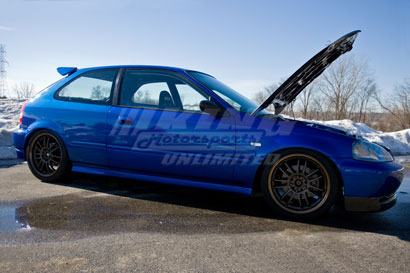
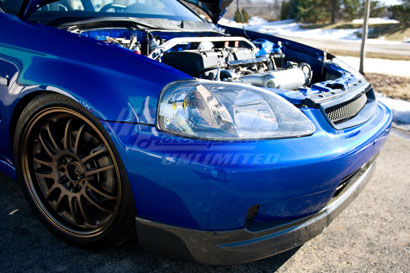
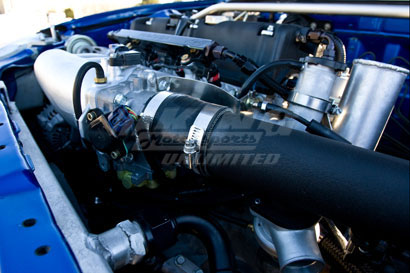
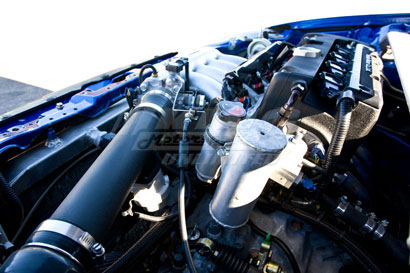
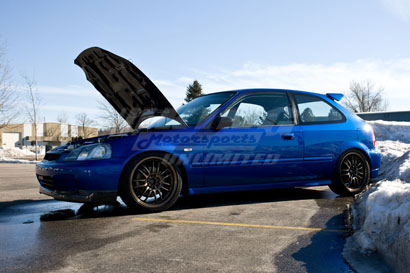
King Motorsports EK4
K Powered EK4
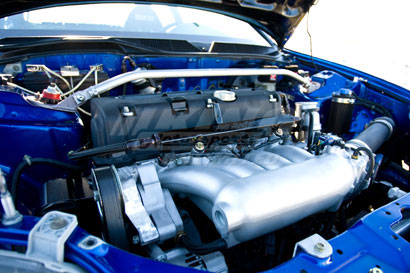
Year: 1997
Make: Honda
Model: Civic DX
Exterior: 2000 Civic Front End, CTR Headlights, CTR Grill, CTR Fenders, CTR Style Carbon Lip, CTR Side-Markers, Thin Side Moldings, Carbon OEM Style Hood, Carbon Mirrors, Carbon Hatch, CTR Rear Spoiler, CTR Rear Lip, CTR Tail Lights and EDM Rear Fog Light. All Weather Strip and Moldings Replaced. Complete Color Change (Long Beach Blue Pearl).
Interior: Dark Gray Interior Swap, Custom Black Carpet, Sparco Seats, Sparco 5 Point Seat Belts, Sparco Harness Bar, Sparco Steering Wheel, Sparco Quick Release, CTR Gauge Cluster, Buddy Club Short Shifter Box, Skunk2 6 Speed Shift Knob, ITR (Yellow Stich) Shift Boot, JDM Airbag Delete, and Custom Carbon Air Vent Block-Off's.
Suspension: Mugen Bushing Kit, Skunk2 Pro C Coilovers, Skunk2 Pro Plus Front Camber Kit, Skunk2 Pro Series Rear Camber Kit, Skunk2 Billet Lower Control Arms, Skunk2 Rear Lower Arm Bar, Skunk2 Custom Front & Rear Strut Tower Bars, CTR 5 Lug Conversion, Skunk2 Extended Wheel Studs, ITR Brake Booster, Techna-Fit Stainless Brake Lines, and Hawk Pads.
Engine 1: Stock Low Mileage K20A2 with a Rotrex C30-94 KraftWerks "Race" Supercharger Kit and KMS Vented Valve Cover.
Engine 2: K24A4 with I Beam Rods, Custom Wiseco Pistons, ARP Studs, Portflow Ported (before working for King) K20A2 Cylinder Head, Skunk2 Pro Series Valve Springs, Skunk2 Pro Series Ti Retainers, Skunk2 Pro Series Spring Base Kit, Skunk2 Pro Series Valves, Skunk2 Stage 3 Cams, Skunk2 Pro Series Exhaust Cam Gear, Type S Oil Pump
Transmission: 6 Speed Type S with ACT Pro-Lite Flywheel, Competition Clutch Stage 2 Disc, Competition Clutch Stage 2 Pressure Plate. ARP Clutch Cover Bolts, and Drive Shaft Shop Level 2.9 Axles.
Mounts: Hasport
Electical: Brand New OEM Type S Engine and Charge Harness. Hybrid Racing Dash Harness and Hondata KPRO.
Fuel System: Walbro 255HP Pump, AEM Fuel Filter, Golden Eagle Pro-Series Fuel Rail, RC Engineering 750cc Injectors and Aeromotive A1000 Fuel Pressure Regulator, Earl's Pro-Lite 350 -6 Hose and Ano-Tuff Fittings throughout.
Induction: KMS Charge Pipes, Precision 500HP Intercooler Core, KMS End Tanks, KMS prep'd RBC Intake Manifold and Go Power Heatshield Intake Manifold Gasket, KMS 64.5mm Throttle Body, Go Power Heatshield Throttle Body Gasket, KMS Throttle Cable Bracket.
Exhaust: Skunk2 Proto-Type MegaPower Race Header, Skunk2 70mm MegaPower R Exhaust.
Cooling H2O: Custom Full Length PWR Radiator, Custom Water Neck with Skunk2 Hi-Pressure Radiator Cap, Spal 13" High Performance Puller Fan and Earl's Pro-Lite 350 -16 Hose and Ano-Tuff Fittings.
Cooling Oil: Earl's Billet Block Adapter, Earl's Pro-Lite 350 -8 Hose and Ano-Tuff Fittings, Earl's One-Way Check Valve, Earl's Billet "Remote Filter" Mount, Fram HP1 Filter, Earl's 14 Row Oil Cooler. 7.5 Qt. System Capacity.
Wheels: Bronze 17" x 7" Volk Racing RE30's, 215/ 40-17 Toyo Proxes 4 Tires, and Project Kics R40 Lug Nuts.
Photo:
source : http://www.kingmotorsports.com
Pinouts OBD1
On this page the OBD1 sheme’s known to me are presented EDM (Europen Domestic Market) style. The biggest difference between EDM and USDM (United States Domestic Market) is the ELD circuit (Electric Load Detection) that misses and the KS (Knock Sensor). Some connections are only found on P28 and P30 ECU’s. Those are marked coloured red. Some connections are different from car to car. Those are marked grey.
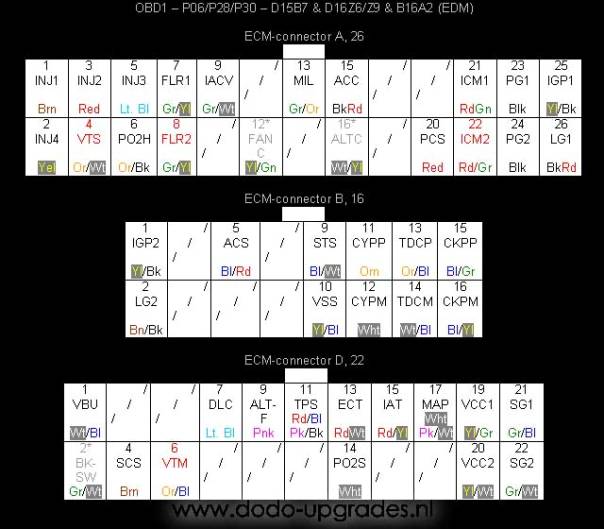
Nomenclature:
ACC - A/C relay
ACS - A/C switch
ALTC - Alternator relay, for control purposes, not present on all ECU’s
ALTF - Alternator switch
BKSW- Brake switch, for control purposes, not present on all ECU’s
CKP - Crankshaft position, (P)ulse or (M)ass, gives several pulses (~20?) during each cam shaft rotation
CYP - Cylinder position, (P)ulse or (M)ass, gives one pulse during each cam shaft rotation
DLC - Diagnostic connector, communication signal to the 3 wire connector next to the SCS connector
ECO - Unknown function (is there an ECO light on D15Z3?)
ECT - Engine coolant temperature
EGR - Exhaust gas recirculation
EGRL - Unknown function (probably related to EGR)
FANC - Fan relay, for control purposes, not present on all ECU’s
FLR - Fuel relay, 1 is always present, 2 can be ignored
IACV - Idle air control valve, controls the 2 wire type IACV valve
IAT - Intake air temperature
ICM - Ignition pulses, 1 is always present, 2 can be ignored
IGP - Battery feed, only active when key is turned
INJ - Injector, the number refers to the cylinder used (1 is on the side with the belts)
LG - Ground for battery circuit
MAP - Manifold absolute pressure
MIL - Motor indication light, this one gives the control engine light (CEL) signal
PCS - Control solenoid, this one is for the small black cylindric valve on the back of the IM
PG - Ground for battery circuit
PO2H - Primary oxygen sensor heater, connects with the ground of the car to activate the heater
PO2S - Primary oxygen sensor signal
SCS - Service connector switch, checks if the SCS connector is hot wired (for reading engine error codes)
SG - Ground for 5V circuit, 1 is for the MAP sensor, 2 is for the other sensors
STS - Starter switch
TDC - Top dead centre, (P)ulse or (M)ass, gives four pulses during each cam shaft rotation
TPS - Throttle position signal
VBU - Back up battery feed, always active (unless battery is removed)
VCC - 5V feed, 1 is for the MAP sensor, 2 is for the other sensors
VREF - Unknown function (probably related to wideband oxygen)
VSS - Vehicle speed sensor
VTM - Oil pressure switch, only -but not always- present on VTEC equiped vehicles
VTS - VTEC solenoid, only present on VTEC equiped vehicles
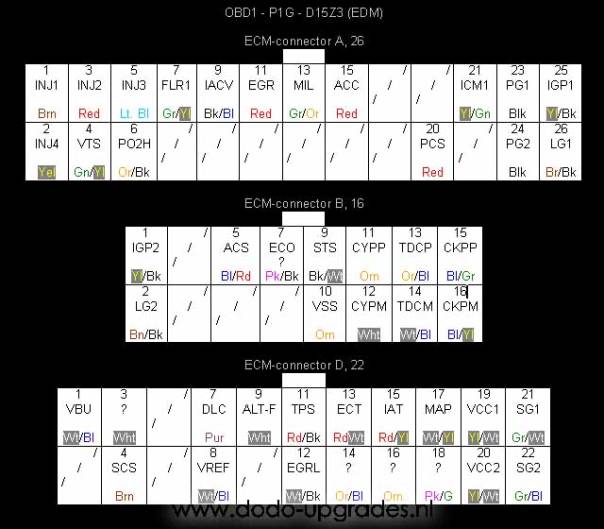
Below I also provided a D15Z3 sheme. Unfortunatly not each function of all pins are known to me. I do know that most question marks are connected to either the EGR (Exhaust Gas Recirculation) and wideband lambda sensor system (Yes this car has a wideband oxygen sensor system normally. However, I do not know the exact possibilities of this sensor). I used the sheme succesfully for a P28 ECU swap once. The wideband lambda wires can be re-used for a normal 4-wire lambda sensor. The VTM pin can be short circuited to the VTS pin to prevent VTEC error codes from the P28 ECU.
Reading error codes on 92-95 Civics (OBD-I Hondas)
Here is the information you need to read error codes on 92-95 Civic and Del Sol (CRX). Those cars are OBD-I, so the same info should be usable for any other OBD-I Honda.

There is a 2-pin (most likely green in color) connector by the ECU or somewhere under the passenger's side dash. It's a Data Link Connector. Connect it's two pins with a piece of wire. Watch out not to get jolted while you're connecting the pins.
You will read error codes on the gauge cluster, on the Malfunction Indicator Lamp. Turn the key to position "II" and watch the lamp blink. Error codes are reported by a number of blinks.
There are short and long blinks. Long blinks mean 10, and short blinks mean 1. For example, if you get "long-long-short-short-short", it means error code 23. There is a short pause between each flash (long or short) and a long pause between 2 error codes. There will always be long flashes before short flashes. So you cannot expect number 23 to be reported as "short-long-short-long-short".
Take note of all error codes reported by ECM (Electronic Control Module). Find a list online that explains "OBD-I error codes honda" and you will find out what your problems are.
Do not forget to remove the wire from the 2-pin connector once you are done.
Honda ECU error codes
0 Bad ecu (if cel is on and no code or light stays on)
1 Oxygen Sensor "A" (Primary) defective circuit or unplugged / defective sensor
2 Oxygen Sensor "B" defective circuit or unplugged / defective sensor
3 MAP Sensor (Manifold Absolute Pressure) defective circuit or unplugged / defective sensor
4 CKP Sensor (Crankshaft Position Sensor) defective circuit or unplugged / defective sensor
5 MAP Sensor (Manifold Absolute Pressure) mechanical problem / disconnected piping
6 ECT Sensor (Engine Coolant Temperature) defective circuit or unplugged / defective sensor
7 TP Sensor (Throttle Position) defective circuit or unplugged / defective sensor
8 TDC Sensor (Top Dead Center) defective circuit or unplugged / defective sensor
9 CYP Sensor (Cylinder) defective circuit or unplugged / defective sensor
10 IAT Sensor (Intake Air Temperature) defective circuit or unplugged / defective sensor
12 EGR Lift Sensor (Exhaust Gas Recirculation) defective circuit or unplugged / defective sensor
13 BARO Sensor (Atmospheric Pressure) defective circuit or unplugged / defective sensor
14 IAC Valve (Idle Air Control) defective circuit or unplugged / defective sensor
15 Ignition Output Signal missing or defective ignition output signal
16 Fuel Injector System defective circuit or unplugged / defective fuel injector
17 VSS (Vehicle Speed Sensor) defective circuit or unplugged / defective sensor
19 Automatic Transmission Lock Up Control Solenoid Valve defective circuit or unplugged / defective solenoid valve
20 Electrical Load Detector defective circuit or unplugged / defective sensor
21 VTEC Solenoid Valve defective circuit or unplugged / defective solenoid valve
22 VTEC Oil Pressure Switch defective circuit or unplugged / defective oil pressure switch
23 KS (Knock Sensor) defective circuit or unplugged / defective sensor
30 Automatic Transmission Signal: "A" / SEAF / SEFA / TMA or TMB defective circuit or unplugged / defective sensor
31 Automatic Transmission Signal "B" defective circuit or unplugged / defective sensor
41 Primary Oxygen Sensor - Heater circuit malfunction
43 Fuel Supply System defective or malfunctioning fuel supply system
45 System Too Lean or Too Rich malfunction in the fuel monitoring systems
48 LAF Sensor (Lean Air Fuel) defective circuit or unplugged / defective sensor
54 CKF Sensor (Crankshaft Speed Fluctuation) defective circuit or unplugged / defective sensor
58 TDC Sensor 2 (Top Dead Center) defective circuit or unplugged / defective sensor
61 Oxygen Sensor, Heated - Sensor 1 (Primary) high voltage, low voltage, or slow response
63 Oxygen Sensor, Heated - Sensor 2 (Secondary) high voltage, low voltage, or slow response
65 Oxygen Sensor Heater (Secondary) malfunctioning or defective oxygen sensor heater
67 Catalyst system Efficiency Below Threshold malfunctioning or defective catalyst system
70 Automatic Transmission malfunction with the automatic transmission controls
71 Cylinder 1 Misfire or a Random Misfire a condition is present that is creating a cylinder misfire
72 Cylinder 2 Misfire or a Random Misfire a condition is present that is creating a cylinder misfire
73 Cylinder 3 Misfire or a Random Misfire a condition is present that is creating a cylinder misfire
74 Cylinder 4 Misfire or a Random Misfire a condition is present that is creating a cylinder misfire
75 Cylinder 5 Misfire or a Random Misfire a condition is present that is creating a cylinder misfire
76 Cylinder 6 Misfire or a Random Misfire a condition is present that is creating a cylinder misfire
80 Exhaust Gas Recirculation insufficient flow detected
86 ECT Sensor (Engine Coolant Temperature) circuit range / performance problem
90 Evaporative Emission Control System leak detected in the fuel tank area
91 Fuel Tank Pressure Sensor low input
92 Evaporative Emission Control System insufficient purge flow


